
Transformer-based UPS vs Transformer-less UPS: Which One Do You Need
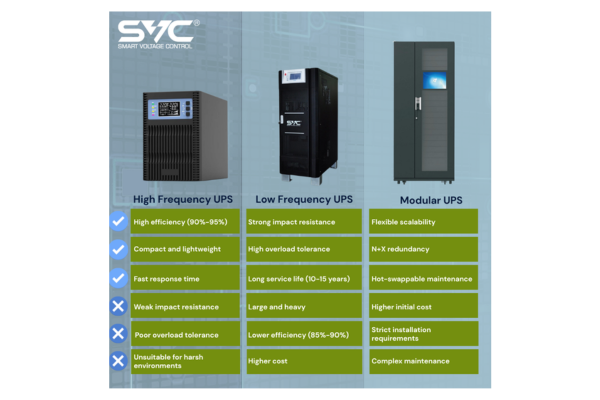
For decades, UPS technology has evolved alongside power semiconductors. Early UPS systems relied on bulky output transformers—these are what we call Transformer-based UPS (Low Frequency UPS). They are durable and reliable, but heavy and less efficient.
Then came Transformer-less UPS (High-Frequency UPS). Enabled by advanced IGBTs and better control technology, it eliminates the output transformer—leading to smaller size, lighter weight, higher efficiency, and greener operation. This represents the latest direction of UPS technology.
And within the transformer-less family, Modular UPS takes flexibility a step further—allowing hot-swappable modules, N+X redundancy, and easy scalability for growing power needs.
Here's a detailed breakdown of all three.
1. Transformer-less UPS (High-Frequency UPS)
Advantages:
-
Compact and lightweight—only 1/3 to 1/2 the volume and weight of same-power transformer-based units
-
High conversion efficiency (90%-95%) with low standby power consumption
-
Fast response time with short transfer switchover during grid abnormalities
Disadvantages:
-
Weak impact resistance; sensitive to grid disturbances such as harmonics and surges
-
Lower tolerance for overload and short-circuit conditions
-
Unsuitable for harsh power environments (voltage fluctuations, dust, extreme temperatures) or inductive loads (motors, pumps)
Best for: small offices, home computers, standard servers, small server rooms
2. Transformer-based UPS (Low Frequency UPS)
Advantages:
-
Built with a large isolation transformer that effectively filters grid harmonics and surges for exceptional impact resistance
-
High tolerance for overload and short-circuit conditions, with strong adaptability to inductive and capacitive loads
-
Long service life of 10-15 years under normal maintenance conditions
Disadvantages:
-
Large and heavy—significantly heavier than same-power transformer-less units
-
Lower conversion efficiency (85%-90%) with higher standby power consumption
-
Higher cost compared to transformer-less UPS of the same power rating
Best for: industrial control systems, medical equipment, mining, chemical plants, harsh environments
3. Modular UPS
As a flexible subset of transformer-less architecture, Modular UPS takes the advantages of high-frequency technology and adds scalability.
Advantages:
-
Flexible scalability—power modules can be added or removed dynamically
-
N+X redundancy eliminates single points of failure
-
Hot-swappable maintenance allows faulty modules to be replaced without system shutdown
Disadvantages:
-
Higher initial cost per module
-
Requires strict installation conditions (standardized cabling, proper thermal design)
-
Increased system complexity demands higher technical expertise
Best for: medium data centers, cloud computing centers, growing businesses
Which One Should You Choose?
| Your Priority | Recommended Type |
|---|---|
| Cost-effective, space-saving, high efficiency | Transformer-less UPS (High-Frequency) |
| Rugged durability, harsh environments, heavy loads | Transformer-based UPS (Line-Interactive Frequency) |
| Future growth, high availability, easy maintenance | Modular UPS |
All three deliver true double-conversion protection. The right choice depends on your environment, load type, and growth plan.
Not All UPS Are Built the Same: Rack, Tower, and Modular UPS Explained
Modified Sine Wave vs Pure Sine Wave: A Quick Comparison
If you are looking for the products for your business please
contact us

+86 75782782286


Headquaters: Block7, No.115, ZhangChayi Road, Foshan, Guangdong, China