
What is a Standard UPS and a Long Backup UPS? A Complete Guide
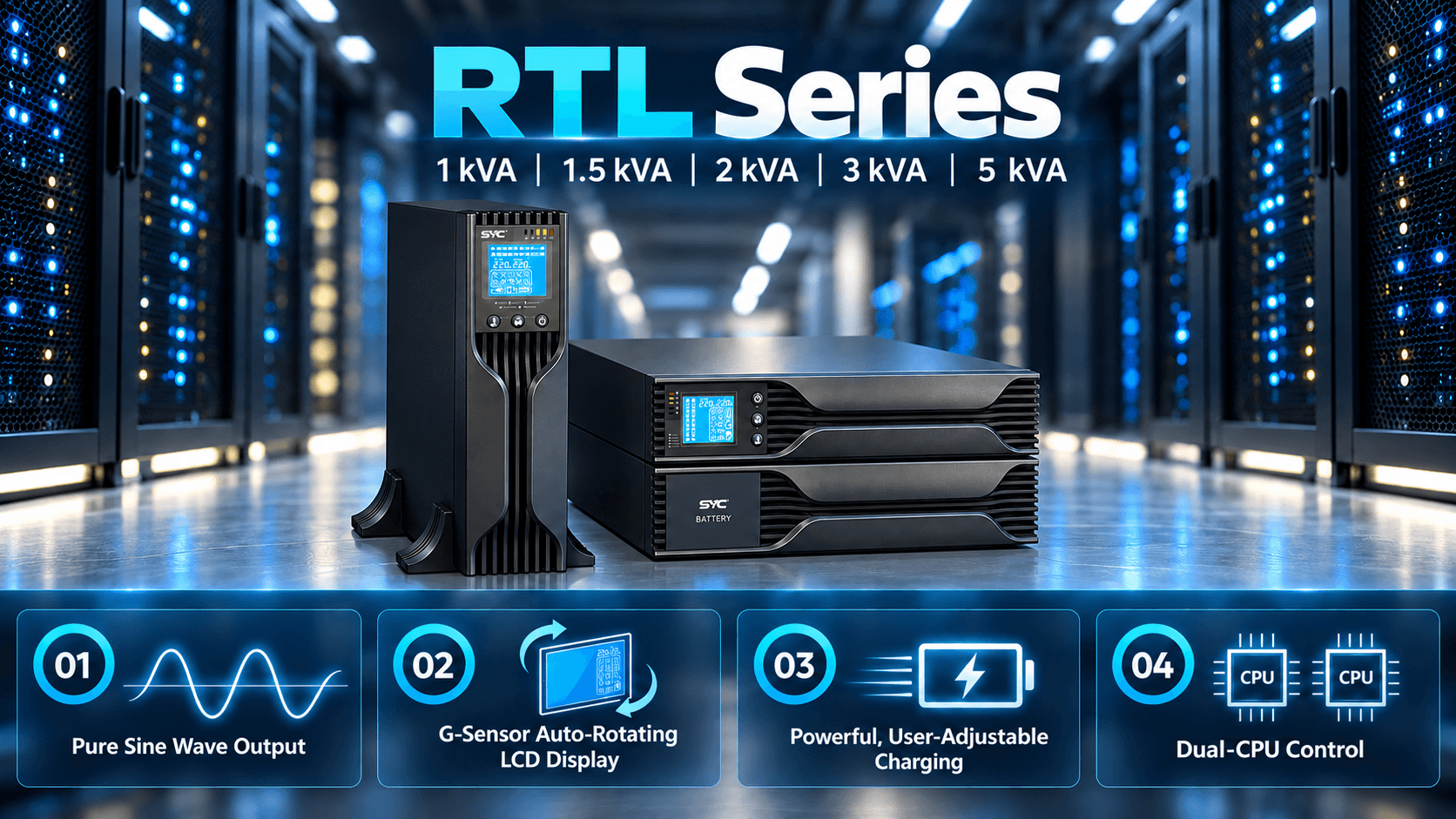
SVC Line-interacitve UPS is available in two models: Standard Model and Long Backup Model. Many customers have questions about the difference between these two models. In fact, the key difference is how the battery is configured. In this guide, we'll explain the differences between Standard and Long Backup UPS models and help you choose the right configuration for your application.
What is a Standard UPS
A Standard UPS is an uninterruptible power supply with a built-in battery. The battery is installed inside the UPS unit, creating a compact and integrated backup power solution.
When the main power fails, the UPS automatically switches to battery power to keep connected equipment running for a limited period of time.
Key Features of a Standard UPS
-
Built-in battery
-
Compact and integrated design
-
Easy installation
-
No external battery cabinet required
-
Fixed battery capacity
-
Suitable for short-term backup applications
Because the battery is integrated into the UPS, Standard Models are convenient for applications where space, simplicity, and ease of installation are important.
Applications of Standard UPS Models
Standard UPS models are commonly used for CCTV, POS system, network equipment, router and switches, NAS system, desktop computers, and small office equipment etc.
For these applications, the main purpose of a UPS is usually to provide enough backup time to prevent sudden shutdowns, protect equipment, and allow users to safely save data or shut down their systems.
What is a Long Backup UPS
A Long Backup UPS is designed to provide extended backup time by using an external battery bank.
Unlike a Standard UPS, the UPS main unit normally does not contain a large built-in battery. Instead, it is connected to an external battery system, allowing customers to select a larger battery capacity according to their backup requirements.
Key Features of a Long Backup UPS
-
External battery connection
-
Flexible battery capacity
-
Longer potential backup time
-
Suitable for extended power outages
-
Easier to customize backup duration
-
Suitable for applications with higher backup-time requirements
The main advantage is flexibility. By using a larger external battery bank, a Long Backup UPS can provide significantly longer runtime than a Standard UPS.
Applications of Long Backup UPS Models
Long Backup UPS models are commonly used for severs, telecom equipment, security systems, industrial control systems, network infrastructure, critical IT equipment and applications requiring extended backup time, etc.
For these applications, a few minutes of backup may not be enough. The system may need to remain operational for tens of minutes or several hours, depending on the application.
Standard UPS vs. Long Backup UPS
The main difference between the two models is the battery configuration.
| Feature | Standard UPS | Long Backup UPS |
|---|---|---|
| Battery Configuration | Built-in battery | External battery |
| Battery Capacity | Fixed | Flexible |
| Backup Time | Generally shorter | Can be extended |
| Installation | Simple | Requires external battery connection |
| Space Requirement | Compact | Requires additional battery space |
| Battery Configuration Flexibility | Limited | High |
| Typical Application | General backup | Extended backupFor these applications, a few minutes of backup may not be enough. The system may need to remain operational for tens of minutes or several hours, depending on the application. |
Neither model is universally better. The right choice depends on your required backup time, equipment, installation environment, and battery configuration.
How to determine the UPS backup time?
One of the most important factors determining UPS backup time is battery capacity.
Battery energy can be roughly estimated using:
Battery Energy (Wh) = Battery Voltage (V) × Battery Capacity (Ah)
For example, a 24V 100Ah battery bank has a nominal energy capacity of:
24V × 100Ah = 2,400Wh
If the connected load consumes 600W, the theoretical runtime can be estimated by:
2,400Wh ÷ 600W = 4 hours
However, actual UPS runtime will normally be shorter than the theoretical calculation because of factors such as:
-
UPS efficiency
-
Battery discharge characteristics
-
Load level
-
Battery age and condition
-
Operating temperature
-
Battery management and protection settings
Therefore, the actual backup time should always be checked according to the specific UPS model, battery configuration, and load.
Frequently Asked Question
1. Can You Add an External Battery to a Standard UPS?
- UPS DC bus voltage
- Battery voltage
- Battery charging system
- Maximum supported battery capacity
- Charging current
- UPS firmware and protection settings
- Manufacturer specifications
2. How to Choose Between a Standard UPS and a Long Backup UPS?
The best UPS model depends primarily on your backup-time requirements.
Choose a standard UPS if
- you need a short-term backup power
-
You want a compact UPS solution
-
You prefer simple installation
-
You don't need a large external battery system
-
Your equipment only needs enough time for safe shutdown
-
Space is limited
Choose a Long Backup UPS If:
-
You need extended backup time
-
Power outages may last for a long period
-
Your equipment cannot be shut down immediately
-
You need flexible battery capacity
-
You need to customize the backup time
-
You are powering critical equipment
The Definitive Guide to UPS Technology, Sizing, and Design
If you are looking for the products for your business please
contact us

+86 75782782286


Headquaters: Block7, No.115, ZhangChayi Road, Foshan, Guangdong, China